
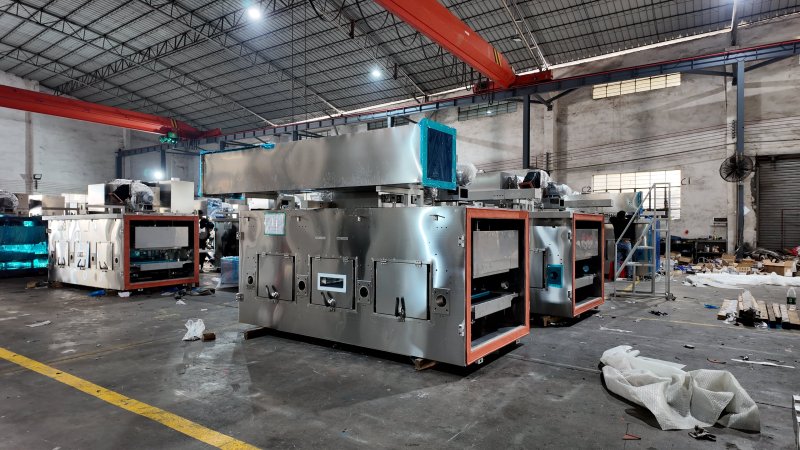
Typical electrode coating ovens operate at working temperatures of 80–150°C, and thermal insulation performance directly affects both energy consumption and drying consistency of the electrodes. Many customers focus on the thickness and bulk density of the insulation material, yet easily overlook a fundamental issue: the effectiveness of the insulation layer depends first and foremost on the sealing integrity and stability of the box welding structure. If the inner liner welds leak air or the outer cover plates warp and deform, no amount of thick insulation can stop heat loss. From a sheet metal fabrication perspective, this article explains our approach to integrated welding of the insulation layer.
1. Fully Welded Inner Liner: The First Line of Defense for Insulation
The inner liner is the surface in direct contact with the hot airflow and forms the inner boundary of the insulation layer. Lithium battery oven fabrication has a hard requirement for this: all inner liner welds in contact with the airflow must be fully welded (seam welded) to guarantee no air or liquid leakage. This means every butt joint of the inner liner must be fully penetrated, with no incomplete or missed welds.
In actual operation, we also perform a bent flange (folded overlap) treatment on the inner liner joint edges of the air duct before full welding, and add reinforcing ribs as needed to ensure structural stability. The overlap structure increases the effective penetration of the weld and reduces the risk of cracking caused by thin-plate thermal distortion. After welding, dye penetrant leak detection is uniformly applied to confirm zero leakage before the module enters the next process step. Only when the inner liner is sealed will heat be prevented from escaping directly through weld gaps.
2. Assembly and Fixing of Insulation Materials
With the welded structure in place, the laying of insulation materials is equally critical. In the lithium battery industry, the typical specification is rock wool with a bulk density > 120 kg/m³, aluminum silicate (ceramic fiber) wool with a bulk density > 128 kg/m³, both rated A1 non-combustible. During assembly, we require staggered, even coverage to avoid aligned joints that would form thermal bridges. In addition, single-layer pipes and blowers must be wrapped with insulation, and bakelite plates are replaced with FR4 fiberglass boards. These details together constitute a complete insulation system.
3. Conclusion
The essence of integrated insulation-layer welding is getting three things right: sealing the inner liner, stabilizing the frame, and flattening the outer cover plates—so that the insulation material can perform at maximum effectiveness within a stable enclosed space. As a sheet metal fabricator, we do not perform thermal engineering design, but we use welding processes to build a solid structural foundation for the insulation layer, giving our customers one less concern in energy consumption and temperature control.