
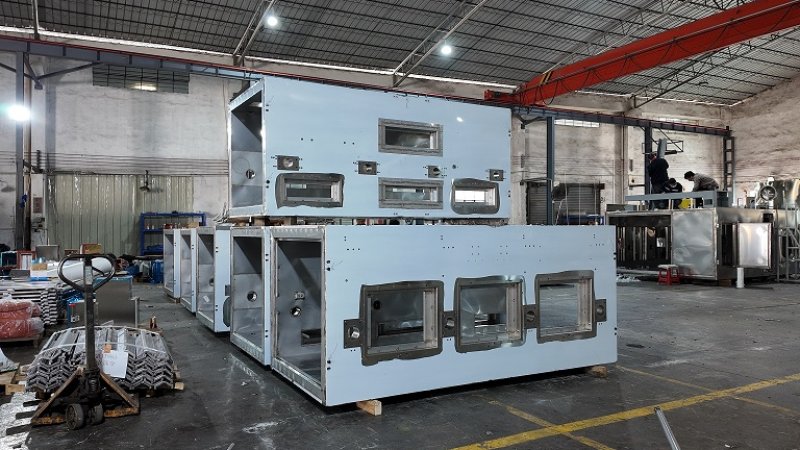
Batch orders often involve dozens of oven modules, and consistency is the core of quality control. On site, the customer assembles modules directly by serial number—if any single module deviates in dimensions, weld quality, or accessory installation, the entire line's schedule is disrupted. Drawing on our manufacturing experience with 36-meter low-speed ovens, this article shares three quality control points in batch production.
1. Incoming Materials: Lock Down the Source First
In production, we strictly use full-thickness materials that meet national standards, as required by the customer. At the incoming inspection stage, we verify material certificates and measured thickness values, eliminating any substitution of inferior materials.
Auxiliary materials have equally hard requirements: door and window sealing strips must withstand 180°C high temperatures; all auxiliary materials must reach a flame retardant rating of V0; gaskets for concentration ports are made of PTFE (Teflon). We convert these requirements into an incoming inspection checklist and verify each item upon delivery of every auxiliary material batch to avoid material mixing. Fasteners (hinges, hinges, leveling feet, etc.) are procured to the customer's specified models, and copper, zinc, and nickel materials are strictly prohibited to prevent electrochemical corrosion with stainless steel.
2. Welding Process: Using Process Discipline to Ensure Consistency
Welding is the step with the greatest variation in batch production. Our common practice is to fix process parameters into the work instructions (SOPs) to minimize human fluctuation.
For example: gusset plates must be added for frame welding to increase strength, and all connecting brackets to the inner liner are fully welded (seam welded). All welds on the inner liner that contact the airflow are also fully welded, followed by developer leak detection after welding—only modules with no air or liquid leakage pass. Outer cover plates use skip welding (5 mm welds at 120–150 mm spacing), ensuring connection strength while controlling thin-plate distortion. During batch production, we conduct patrol spot-checks on these process requirements; any abnormality is immediately reworked.
For appearance control, we require weld spatter to be removed and welds ground flush, but the outer surface must not be ground—it must maintain uniform gaps and no warping. During batch production, a dedicated inspector performs an initial visual check on every module right after the welding process, preventing non-conforming products from flowing into the next process step.
3. Final Inspection: Every Module Is a Finished Product
Before each box leaves the factory, we complete inspections according to the fabrication specification, for example:
Critical dimension re-verification: frame diagonal error within 3 mm, box end-face flatness ±2 mm, air nozzle mounting surface flatness ±1.5 mm. In batch production, we combine sampling inspection with first-article confirmation—the first article receives a full inspection, and thereafter every fifth module is sampled.
Functional confirmation: after doors and windows are closed, the gap must be no more than 3 mm; air nozzles are test-fitted on site to confirm they can be removed and installed normally; each module is labeled with a serial number to avoid confusion on site.
Cleaning and protection: internal debris and dust are thoroughly cleaned, weld rust stains are washed off, 3M warning labels are applied at forklift positions, and the static pressure chamber is firmly fixed with wooden battens before shipment.
4. Conclusion
The essence of quality control in batch-producing 36-meter low-speed ovens is not making one single module perfect, but rather keeping every module stable at the same level. From incoming material verification, welding process standardization, to per-module final inspection, we break down the requirements of the fabrication specification into every workstation, so that every module the customer receives can be hoisted directly and mated smoothly.