
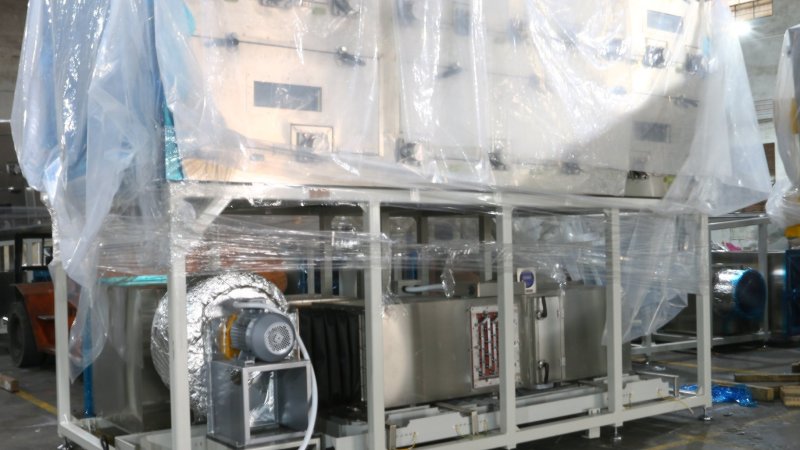
The modules of separator coating machine ovens are joined by flange connections. The gaps at these joints may look like a mere assembly issue, but in fact they directly affect the airflow uniformity inside the oven—air leakage through gaps causes local airflow velocity drops and temperature fluctuations, which ultimately show up in the shrinkage rate of the separator during drying. As a sheet metal fabricator, our control of joint gaps at the manufacturing stage extends all the way from end-face machining to sealing assembly.
1. End-Face Flatness: The Root of Gaps Is Determined at the Manufacturing Stage
The size of a joint gap depends first and foremost on the flatness of each module's end face. If the end face itself is uneven, no amount of bolts or thick sealing gaskets applied on site can fully close the gap. After welding and straightening, we perform dedicated inspections on the box end faces, keeping flatness within 2 mm and angular deviation likewise within 2 mm. The flatness of flange mating faces is further tightened to within 1 mm, creating the conditions for uniform compression of the sealing gasket in the subsequent step.
End-face straightening is not simple grinding—it is a whole-surface correction performed on the end face with dedicated fixtures after frame welding is completed, ensuring the end face remains perpendicular to the main axis of the module. Only when the end face is "true" can two modules mate naturally, rather than being forcibly pulled together by bolts.
2. Sealing Structure: The "Last Mile" of Gap Control
With end-face flatness in place, the selection and installation of sealing materials determine whether gaps are truly sealed. We use a 5 mm foamed silicone gasket as the primary seal between flanges. The foamed silicone gasket offers excellent compression resilience, adapts to minor surface irregularities, and maintains its sealing performance under high-temperature operating conditions.
Beyond the flange faces, all thermal bridge locations are covered with sealing strips to prevent heat and airflow from escaping through structurally weak points. Butt joints inside the air duct are uniformly sealed with adhesive (caulking), because the internal duct air pressure is relatively high—even a tiny gap there leads to noticeable air leakage. The gap after doors and windows are closed is controlled to within 3 mm, paired with hollow foamed silicone sealing strips to ensure no air leakage when closed.
3. Single-Module Delivery: "Zero Adjustment" Joint Assembly on Site
We adopt a model of independent manufacturing and independent delivery for each module. When each module leaves the factory, its end faces have already been straightened, and the sealing strips and flange gaskets are pre-installed. On the customer's site, workers only need to mate the flanges of two modules in numerical order and tighten them with M6 stainless steel screws. With end-face accuracy secured upfront, no fitting, no patch welding, and no extra gasket shimming is needed on site.
If end-face accuracy fails to meet the standard, on-site crews are often forced to thicken gaskets or perform local patch welding to close gaps. This not only increases installation labor hours but, more importantly, compromises the original sealing design and leaves hidden long-term air leakage risks.
4. Conclusion
The impact of joint gaps on the airflow field in a separator oven is, in essence, a matter of "manufacturing accuracy determines assembly quality." By getting three things right in the factory—end-face flatness, flange face flatness, and sealing material assembly—we make on-site joint assembly simple and reliable for our customers. Only with gaps well controlled can the airflow field remain stable, and the coating quality of the separator be assured.