
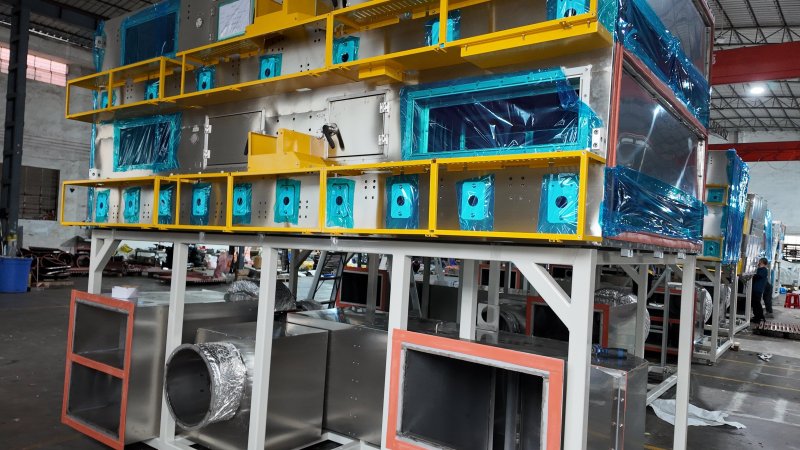
Separator coating is extremely sensitive to airflow uniformity—even the slightest difference in air nozzle outlet gaps will show up directly in the shrinkage rate of the separator during drying. As a sheet metal fabricator, we have developed a process of "validate first, minimize welding, fine-tune precisely, then inspect" in air nozzle manufacturing and installation, ensuring consistency across the entire nozzle array.
1. Prototype First, Then Batch Production: No Investment Without Confidence
Air nozzle structures vary with each customer's design. We never go straight into batch blanking upon receiving drawings. Instead, we first produce a single air nozzle prototype to verify whether the forming process is feasible, whether the rivet positions are reasonable, and whether the fit with the air chamber is smooth. All problems found during prototyping are resolved before batch production begins. This may seem like an extra process step, but it actually avoids the risk of batch rework and ensures consistency across the dozen or even dozens of nozzles that follow.
2. Rivet-Forming as Primary, Welding as Supplementary: Controlling Thermal Distortion at the Source
The overall forming of the air nozzles relies primarily on riveted connections, supplemented by welding only where necessary. The reason is simple: welding heat input is the leading cause of sheet metal distortion. Nozzle walls are thin and dimensional accuracy requirements are high—if large amounts of welding were used, it would be very difficult to restore accuracy through post-weld correction.
Rivet forming not only reduces thermal distortion but also keeps the relative positions of the nozzle's sheet metal parts stable. During batch production, we use dedicated fixtures to hold the nozzle components in place, ensuring that every nozzle is formed in exactly the same state as the prototype.
3. Gap Adjustment, Chamber Fit, and Leak Test: Three Gates of Verification
After forming, the nozzles are not simply packed and shipped. We adjust the nozzle gap of each individual nozzle, controlling the outlet spacing within a reasonable tolerance range to ensure consistent airflow accuracy from every nozzle. This step involves manual fine-tuning that depends on the operator's experience and patience—but it is also the last line of manufacturing assurance for airflow uniformity.
Once gap adjustment is complete, the nozzles are mounted onto the air chamber for trial assembly and leak testing. We simulate actual operating conditions, checking whether there are gaps at the mating surfaces between nozzles and the chamber, whether the latches are secure, and whether there are any abnormal air leakage points overall. Only nozzle assemblies that pass these tests are delivered together with the oven module.