
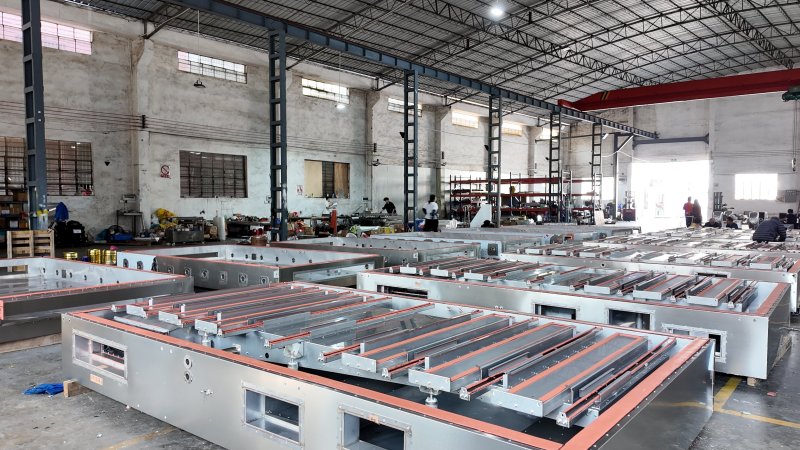
Though both are called coating machine ovens, the structural differences between gravure primer coating (bottom coating) machines and standard electrode coating machines are actually quite significant. We compare two actual delivered projects: one is a double-layer 18-meter primer coating oven (3 modules per layer, each module 3 meters), and the other is a 36-meter single-layer standard electrode oven (with as many as 20 modules). Understanding these differences is essential to knowing where the sheet metal fabrication focus lies for each type.
1. Size and Layout: "Long and Single" vs. "Short and Double"
A standard electrode oven is a 36-meter single-layer long oven with many modules and pronounced batch-production characteristics. It is also equipped with a full-length operator walkway—covered with anti-slip rubber mats and edge-pressed with aluminum trim—which itself represents a considerable amount of sheet metal work. The fabrication challenge for this type lies in batch consistency: any two of the 20 modules must be interchangeable in assembly, with end faces, flanges, and hole positions all matching. This tests the process discipline of batch production.
A primer coating oven, by contrast, uses a double-layer structure with only 9 meters per layer, but the upper and lower layers are independent yet must cooperate with each other. The challenge of this type is not "length" but inter-layer correspondence—the flange interfaces, connecting bracket positions, and assembly datums of the upper and lower layers must be strictly aligned; otherwise, the two layers cannot be matched on site.
2. Temperature and Insulation: The Gap Between 3 mm and 5+10 mm
Standard electrode ovens operate at relatively low temperatures, with an insulation configuration of 120 kg/m³ rock wool plus 3 mm aerogel. The insulation material only needs to meet UL94-V0 flame retardancy.
Primer coating ovens run at higher drying temperatures, and their insulation configuration is significantly upgraded: aluminum silicate (ceramic fiber) wool with a bulk density above 128 kg/m³, rated A1 non-combustible; 5 mm aerogel applied on the outer side of the frame and 10 mm on the inner side, covering all six faces; rock wool also filled inside the frame's square tubes. Auxiliary material flame retardancy requirements are also more stringent. For a sheet metal fabricator, this means a much larger aerogel coverage area and more demanding placement accuracy on primer coating ovens, while the high-temperature operating conditions impose stricter requirements on weld sealing integrity and thermal distortion control.
3. Structural Details: Different Priorities
A standard electrode oven has many modules, and the circulation fan volutes are welded directly onto the box inner liner. Dedicated fixtures are required to guarantee coaxiality within ±2 mm, and with a large number of fans, every single one must be accurately positioned. Some insulation components also involve material substitutions—ceramic fiber parts replaced with asbestos rubber sheets, and bakelite plates replaced with FR4 fiberglass boards—so incoming material verification must be strict.
A primer coating oven has fewer modules and no walkway, but it has more inter-layer connecting structures, making the uniformity of assembly datums between the upper and lower layers even more critical.
4. Conclusion
The "fundamentals" are the same for both types of ovens: fully welded frames, fully welded inner liners with dye penetrant leak detection, skip welding on outer cover plates, and door/window sealing—these requirements are met without compromise. The real difference lies in what each type tests: the standard electrode oven tests batch consistency, while the primer coating oven tests high-temperature sealing and inter-layer precision. Doing both well does not come from one universal process, but from reading the process requirements behind the drawings and implementing them in the respective process controls.