
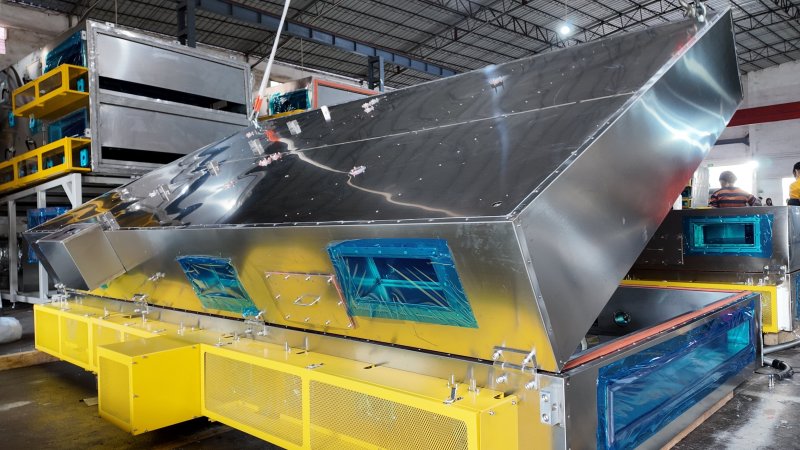
The coating thickness of the primer coating (bottom coating) process is only 0.3–2 μm, making it one of the thinnest coatings in electrode coating. Such an ultra-thin coating is extremely sensitive to the drying environment—any air leak inside the oven causes local fluctuations in temperature and airflow velocity, which ultimately manifest as uneven primer coating thickness and excessive solvent residue. Therefore, the airtightness requirements for primer coating ovens are far more stringent than those for standard electrode ovens. As a sheet metal fabricator, we ensure airtightness at the manufacturing stage mainly through the following three aspects.
1. Fully Welded Inner Liner: The Foundational Work for Airtightness
The inner liner of a primer coating oven is in direct contact with the hot airflow, and every weld is a potential air leakage point. In manufacturing, we insist on full welding (seam welding) of the entire inner liner—no tack welding or incomplete welding is allowed. The challenge of full welding lies in distortion control: thin plates exposed to prolonged heat tend to develop wavy deformation, which is very difficult to straighten after welding.
Our countermeasure is: the joint edges of the air duct inner liner are first given a bent overlap (folded flange), and then fully welded. The overlap structure increases the effective weld penetration while limiting plate misalignment during welding—ensuring sealing integrity while reducing distortion risk. Internal butt joints of the box are laser-welded wherever possible, further minimizing the heat-affected zone.
After welding, we uniformly perform dye penetrant leak detection, checking every inner liner weld one by one and confirming zero leakage points before the module enters the next process step. Although this operation adds labor hours, it is an indispensable quality checkpoint for a process as airtightness-sensitive as primer coating.
2. Door and Window Sealing: Airtight Assurance at High-Frequency Opening Points
Doors and windows are the most frequently used components on an oven and the locations where airtightness is most likely to fail. For primer coating ovens, the gap after closing is controlled within 3 mm, and protrusion beyond the mating plane is kept within 2 mm. If the gap exceeds tolerance, the sealing strip compresses unevenly, and after long-term use the strip develops localized fatigue, with leakage points gradually expanding.
The sealing strips are made of hollow foamed silicone material, resistant to temperatures above 180°C. The splicing method of the strips also matters—the cut ends of adjacent strip segments are staggered rather than concentrated at one location, preventing the formation of a continuous leakage path. Door and window frames are likewise fully welded and ground flat, ensuring the strip is evenly compressed along the entire closing path.
3. Flanges and Flexible Connections: Airtight Details Under Dynamic Conditions
The modules of a primer coating oven are connected by flanges, with a 5 mm foamed silicone gasket between flange faces, tightened with M6 stainless steel screws. The compression resilience of the foamed silicone gasket can compensate for minor unevenness of the flange faces—but the precondition is that the flatness of the flange faces themselves must meet the standard. Before leaving the factory, we inspect every flange face to ensure the gasket compresses evenly, with no local floating gaps.
Inside flexible connection sections, SUS304 stainless steel wire support is used, with wire spacing controlled at 70 mm, preventing the flexible connection from being sucked flat and deformed under negative-pressure operating conditions, which would cause air leakage. The interface welds between flexible connections and the box are likewise required to be fully welded, followed by leak inspection after assembly.
4. Conclusion
The airtightness of a primer coating oven is, in essence, a combined reflection of weld quality, sealing surface precision, and sealing component assembly processes. From the fully welded inner liner to leak detection verification, from door and window sealing to flange gaskets, we break down airtightness requirements into every sheet metal process step, keeping the drying environment for the ultra-thin primer coating stable and controllable.