
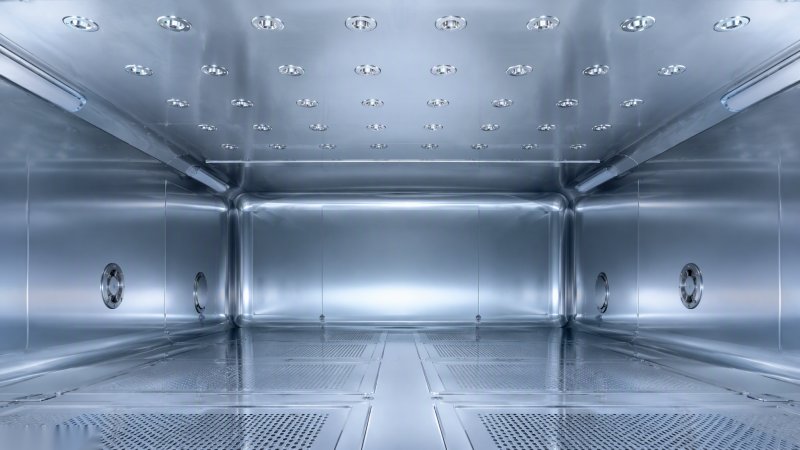
Optical film coating and lithium battery coating may appear to follow the same process route of "coating + drying," but the product characteristics are entirely different: lithium electrodes care about coating capacity and cycle life, whereas optical films care about optical uniformity—any tiny thickness fluctuation, particle defect, or uneven thermal shrinkage will show up on the screen as bright spots or rainbow patterns (mura). These two product logics determine the marked structural differences between the ovens.
1. Different Design Priorities: Cleanliness-First vs. Explosion-Protection-First
The design priority of a standard lithium battery oven is safety and solvent recovery: because NMP solvent is used, the oven needs concentration sampling ports, explosion relief vents, and NMP recovery piping. The structural design focus is the safe management of solvent vapor and recovery efficiency.
The design priority of an optical film oven is particle control: most optical adhesives and coatings use water-based or low-toxicity solvents, so explosion-proof pressure is minimal, but particle sensitivity is extremely high. Structurally, this is reflected as: inner walls designed to be smooth with no dead corners, all welds fully ground, and any structural protrusions that could trap dust or shed debris eliminated; fresh-air and exhaust connections must be designed to work with the cleanroom FFU system, preventing external particles from flowing back in. For a sheet metal fabricator, the inner wall finishing workload of an optical film oven is often much greater than that of a lithium battery oven of the same size.
2. Different Tolerance for Temperature Uniformity
Lithium electrodes have a certain tolerance for temperature fluctuations—temperature control accuracy of ±2°C to ±3°C meets the requirements of most processes.
Optical films are completely different. Polarizer films and brightness enhancement films use PET and other polymer films as substrates, and their thermal shrinkage rate is extremely sensitive to temperature—if the same film passes through a non-uniform temperature field inside the oven, it will warp and shrink unevenly after exiting, and its optical performance is scrapped outright. Therefore, the requirements for airflow uniformity and temperature stability of an optical film oven are an order of magnitude higher than those of a lithium battery oven. This is reflected in the sheet metal structure: air nozzles must be machined with higher precision and installed more consistently, and the air chamber must meet stricter sealing requirements—because any local airflow velocity difference will ultimately be amplified into a temperature difference on the film surface.
3. Different Substrates: Thinner, Easier to Scratch, More Tension-Sensitive
The substrates for lithium battery coating are copper foil and aluminum foil, 4.5–20 μm thick but with relatively high strength. Optical films use PET substrates that are equally thin but softer and much easier to scratch, making them far more demanding on the web-running environment.
This means optical film ovens must be more refined in structural details: the flatness of roller mounting faces must be higher to prevent roller tilt from causing wrinkles; the edges of box openings and inspection windows must be deburred and polished—no sharp edges that could scratch the film; and internal fasteners are subject to stricter requirements to prevent loose parts from falling off and getting wrapped into the film.
4. Conclusion
In summary, a standard lithium battery oven follows a "safety-first, efficiency-oriented" structural logic, while an optical film oven follows a "cleanliness-first, precision-oriented" structural logic. Our manufacturing processes are the same for both product types—the fundamentals of full welding, leak detection, straightening, and precision machining remain unchanged—but an optical film oven pushes every single requirement to a more stringent level. Only by understanding this difference can both product types be built right.