
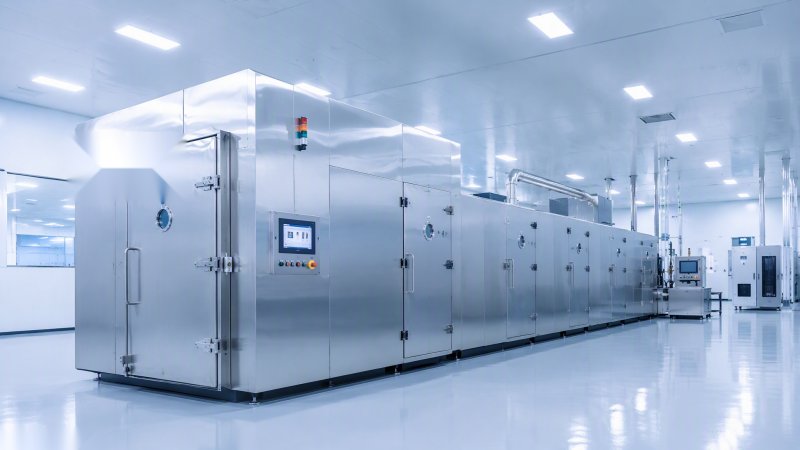
As a sheet metal fabricator, although we do not have a cleanroom facility, we can systematically control contaminants during manufacturing, delivering boxes that are ready for direct assembly inside the customer's cleanroom. The following are three control points summarized from our actual production experience.
1. Blanking Stage: Reducing Dust Generation from Cutting
One of the biggest sources of metal particles is the cutting process itself. Our practice is: clean-side panels such as the inner liner are laser cut as a priority. Compared with plasma cutting, laser cutting produces a narrow kerf, a small heat-affected zone, and virtually no oxide slag, leaving minimal residue on the plate surface.
After cutting, every part must be deburred individually—burrs are the most common "self-generated particles" on sheet metal parts. They detach during transport vibration and enter the air duct directly. This work may seem basic, but it is easily overlooked in batch production. It must be included in the process inspection checklist, rather than left to the next process to "handle along the way."
2. Welding and Grinding: Controlling Dust Generation and Eliminating Dead Corners
Welding is another key contamination process. If weld slag and spatter remain inside the box, they peel off with airflow during operation and contaminate the film surface directly. Our requirement is: 100% removal of weld slag and spatter after welding, with welds ground flush—no porosity or slag inclusions allowed. These defects are not only sealing hazards but also dust traps.
In terms of the internal box design, we work with the customer to avoid right-angle dead corners and blind-hole structures wherever possible, with sharp edges deburred and rounded. Dust accumulated in dead corners is extremely difficult to clean inside a cleanroom. Rounded transitions combined with flush welds allow the inner walls to be wiped clean with lint-free wipes in one pass, instead of digging dust out of every seam.
It is worth noting that the grinding process itself generates dust, so after grinding, a thorough cleaning is mandatory—simple air blowing is not acceptable. Compressed air blasting merely moves dust from one place to another; it does not actually remove it.
3. Surface Treatment and Pre-Delivery Protection
After stainless steel welding, the heat-affected zone discolors and oxidizes, and its corrosion resistance decreases. These oxide layers can peel off in hot and humid environments and become particle sources. We perform pickling and passivation on clean-side welds to restore the surface condition, while removing oil stains and fingerprints picked up during fabrication.
Before leaving the factory, a final cleaning of the box interior is completed, and all openings are sealed with protective film to prevent dust and debris from entering during transport. Moisture-proof and dust-proof packaging ensures that when the customer opens the crate, the box interior is in the same clean condition as when it left the factory.
4. Conclusion
Cleanliness for optical film ovens is half achieved by the customer's cleanroom and half by the sheet metal fabricator's process control. Every contamination source—from blanking dust and welding residue to grinding particles—has a corresponding control method. Cleanliness is not wiped on at the end; it is controlled from the very first cut—and that is our commitment to optical film customers.