
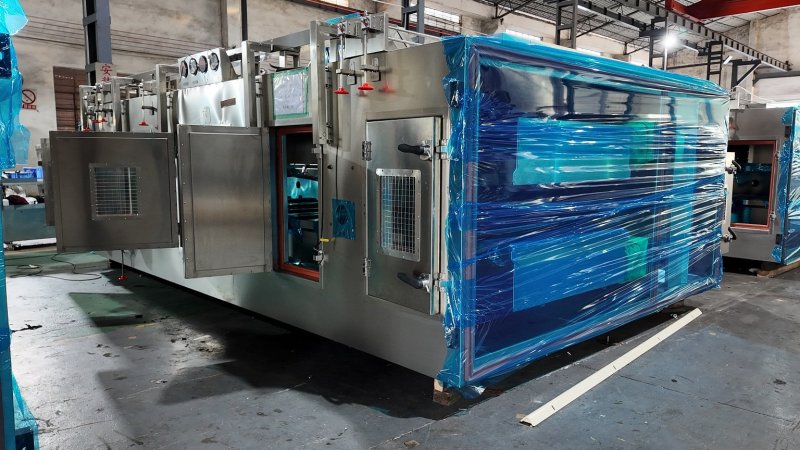
Most high-speed electrode coating drying ovens use a double-layer structure, with a total line length that can reach 60 meters. We manufacture each oven module independently—each section is fully assembled and inspected at our factory before delivery, and is then hoisted directly into place at the customer's site according to its serial number.
This delivery model means there is no opportunity for on-site rework. The structural accuracy of each individual module has to be inherently sound.
Drawing on our hands-on manufacturing experience, this article shares our approach in three areas: the box frame, end-face control, and single-module delivery.
1. Frame Welding: Where All Accuracy Begins
The oven box frame is assembled by welding profile sections together, and it forms the structural foundation of the entire unit. If the welded frame deforms beyond tolerance, every panel installed afterward will be off as well.
Our practice: after frame welding is completed, the diagonal error is strictly controlled within 3 mm. This tolerance may look generous, but for a welded frame several meters long, it can only be achieved through a well-planned welding sequence and proper jig constraints.
All connecting brackets between the oven frame and the inner liner are fully welded (seam welded). To prevent frame distortion during this process, we first square the frame diagonals and lock them in place with fixtures throughout the welding operation. After the box is fully formed, a second measurement and re-squaring is carried out, ensuring that the diagonals of every oven module meet the standard.
In terms of welding strategy, the outer cover plates use skip welding (5 mm welds at 120–150 mm spacing), while internal butt joints are laser-welded wherever possible. The objective is clear: to minimize heat input and control distortion in thin plates (typically 2–3 mm stainless steel) while still meeting the required joint strength.
2. End Faces and Interfaces: The Core Control Items for Single-Module Delivery
Once each oven module is delivered, it is connected to adjacent modules on site by flanges and bolts. The flatness and angularity of the end faces directly determine whether multi-level, multi-module assemblies can mate smoothly.
End-face flatness within ±2 mm, and angular deviation within ±2 mm. After welding and straightening, we perform dedicated inspections on the end faces. Note that the end-face angles of different oven modules on a coating machine may vary slightly—these subtle differences are typically ensured during the CNC press-brake stage using dedicated checking fixtures, so that upper and lower layers, as well as front and rear modules, fit together naturally at the joints, without gaps or interference caused by angular accumulation.
3. Conclusion
The precision of a double-layer high-speed drying oven is not "adjusted" into place on site—it is accumulated by building solid structural accuracy into every module during manufacturing. From diagonal control of the frame to module-by-module management of end-face angles, we break down the line-level assembly requirements into every module and every weld, making on-site installation faster and more hassle-free for our customers.