
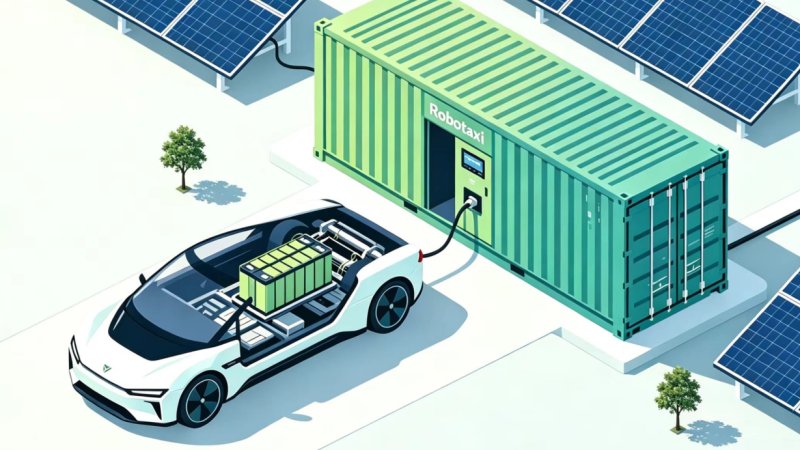
Industry Trends: Second-Life Batteries – The Next Milestone in the Green Supply Chain
[June 2026] As autonomous fleets scale globally, second-life battery utilization is turning into a massive industrial reality. Autonomous driving leader Waymo has partnered with energy storage specialist B2U Storage Solutions to repurpose retired robotaxi battery packs into stationary solar storage assets, supporting fast-growing green grids in California and Texas.
The Challenge & Mechanism: Capturing Extended Value
Operating within all-weather autonomous fleets means robotaxi batteries accumulate wear much faster than private cars, leading to shorter automotive lifespans. However, these retired packs still retain substantial residual capacity.
B2U conducts rigorous performance testing on these units before integrating them into standardized, container-sized storage cabinets. These systems act as grid buffers: they charge during the day when solar power is abundant and low-cost, and discharge back into the grid during peak evening hours when solar production declines. A single cabinet can supply enough electricity to power an average home for up to three months, reducing industrial waste while creating significant commercial value.
Industry Insight
The transition of batteries from dynamic vehicles to stable stationary storage is an inevitable step toward a closed-loop energy lifecycle. From a fabrication perspective, this trend introduces strict demands for durable storage enclosures, precise internal modular assembly, and rigorous safety gating.
As a trusted partner in precision custom fabrication and modular pre-assembly, we closely monitor every structural detail across the lithium-ion lifecycle, delivering the robust hardware foundations necessary to bring green energy solutions into reality.
Source Credit
This content is synthesized from official project briefings by Waymo and B2U Storage Solutions (June 2026) for industry knowledge sharing. All trademarks and technical copyrights belong to their original entities.