
Frontier Technology: Bridging Lab to Line – How Silicon-CNT Anodes are Defining the New Era of High-Energy Batteries
[March 2026] As global demand for electric vehicles (EVs) and long-duration energy storage surges, the breakthrough in lithium-ion energy density has reached a critical turning point. Recently, the Advanced Technology Institute (ATI) at the University of Surrey unveiled a revolutionary research achievement: the VISiCNT (Vertically Integrated Silicon-Carbon Nanotube) structure. This innovation successfully bridges the gap between silicon’s immense storage potential and long-term cycle stability.
The Breakthrough: Pushing the 3,500 mAh/g Limit
Traditional lithium batteries rely on graphite anodes, which are limited to a theoretical capacity of 372 mAh/g. In contrast, the VISiCNT anodes developed by the ATI team have demonstrated a mass energy density exceeding 3,500 mAh/g in laboratory tests—nearly 10 times that of current commercial batteries. This leap suggests that for the same weight, battery range could see an exponential increase.
The Core Process: Engineering a Nanoscale "Elastic Scaffold"
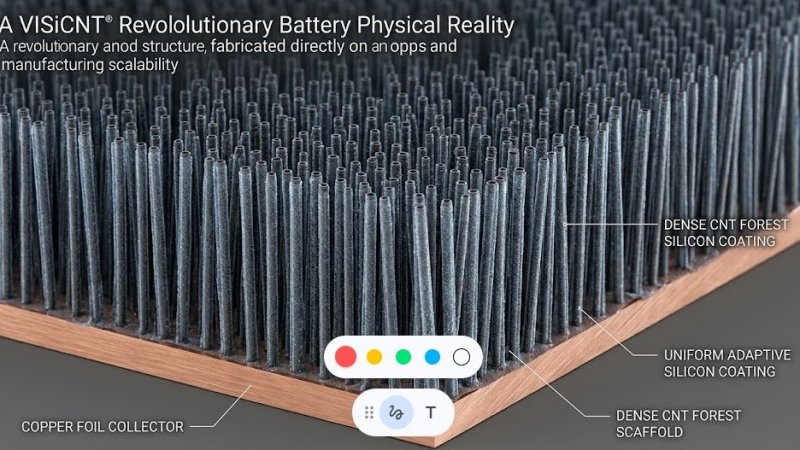
For years, the primary obstacle to silicon anodes has been their dramatic volume expansion (up to 300%) during charge-discharge cycles, leading to structural pulverization and short life cycles. The VISiCNT technology solves this by growing a dense "forest" of carbon nanotubes directly onto copper foil and coating them with a thin layer of silicon. This creates a highly flexible, conductive scaffold that acts like a microscopic spring, absorbing the volume changes of silicon while ensuring the battery remains stable over hundreds of cycles.
Manufacturing Perspective: Scalability and Line Compatibility
From a fabrication standpoint, the most significant highlight of this technology is its industrial potential. Unlike previous cost-prohibitive laboratory solutions, the VISiCNT process offers:
- Current Collector Compatibility: It is grown directly on copper foil, the standard material used in commercial battery production.
- Process Adaptability: It utilizes a scalable manufacturing method designed to be integrated into existing industrial production lines with minimal disruption.
This marks a decisive step for carbon nanotube technology, moving beyond academic research and into the realm of real-world, large-scale manufacturing.
Industry Insight
Regardless of how chemical systems evolve—from the growth of carbon nanotube forests to the uniform coating of silicon layers—the essence remains the pursuit of micro-structural physical stability. As a partner in precision fabrication, we understand that a stable, reliable physical foundation is the prerequisite for any cutting-edge material to achieve mass production. We are committed to using high-precision manufacturing processes to help transform global scientific achievements into high-efficiency, long-lasting physical realities.
Source Credit
This content is synthesized from official research briefings by the University of Surrey and industry reports from March 2026. This article is intended for industry knowledge sharing; all technical copyrights belong to the original research institutions.