
Lead-in:
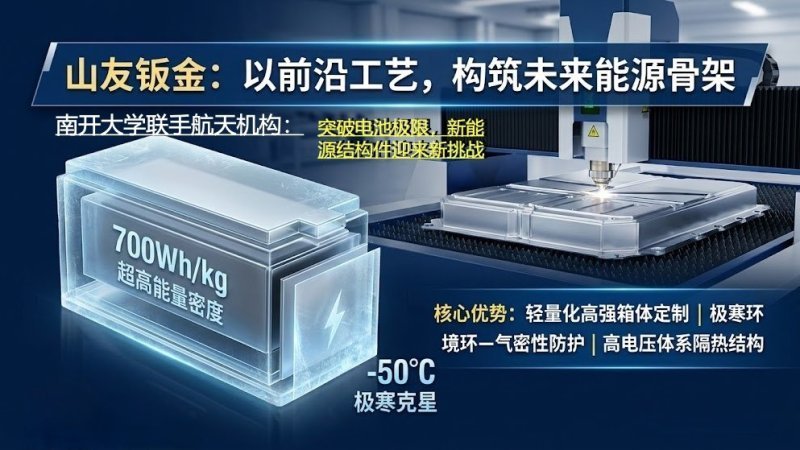
In February 2026, the battery world witnessed a "seismic" breakthrough. Nankai University, in collaboration with the Shanghai Institute of Space Power Sources, pushed lithium battery energy density to a new height of 700 Wh/kg through a revolutionary "fluorinated hydrocarbon" electrolyte design. This figure means that future electric vehicles will not only double their range but also deliver full performance in extreme cold at -50°C.
I. Core Breakthrough: A Generational Leap from "Carbonates" to "Fluorinated Hydrocarbons"
For a long time, lithium batteries have struggled to balance higher energy density with stability under extreme conditions. The core of this research lies in a molecular-level reconstruction of the battery's "blood"—the electrolyte.
- An astonishing 700 Wh/kg density: This figure is 2.8 times that of today's top commercial batteries (such as CATL's, at roughly 250 Wh/kg).
- Conquering the extreme-cold "forbidden zone": While conventional batteries suffer severe performance drops below -20°C, the new technology maintains a high energy output of 400 Wh/kg even at -50°C.
- 4.9 V high-voltage stability: The new solvent not only conducts ions rapidly but also offers extremely high oxidative stability, providing a safety foundation for high-voltage battery systems.
II. Technology Decoded: Why "Fluorination" Is the Key
In the journal Nature, the research team detailed the principles behind this breakthrough technology. They synthesized a series of novel fluorinated hydrocarbon solvent molecules, fundamentally changing the way ions are transported:
- Breaking the "lithium–oxygen" bondage: Conventional electrolytes rely on oxygen atoms to coordinate lithium ions and become highly viscous at low temperatures. The new technology utilizes a "lithium–fluorine (Li–F)" coordination mode, significantly reducing resistance to ion movement.
- Extremely low viscosity: The electrolyte, based on 1,3-difluoropropane (DFP), has a viscosity of only 0.95 cP. Even in laboratory conditions as extreme as -70°C, ions remain highly mobile.
- Steric hindrance design: By adjusting the spatial arrangement of solvent molecules, the team achieved a high salt solubility of over 2 mol/L, paving the way for high energy output.
III. Industry Outlook: More Than Just Doubled Range
Although the achievement remains at the laboratory stage, its commercialization blueprint has sparked boundless imagination:
- Electric vehicles (EVs): Put an end to winter "range anxiety" once and for all, allowing car owners in cold northern regions to enjoy long-range driving too.
- Aerospace and robotics: With ultra-lightweight, extreme-environment-tolerant characteristics, deep-space probes and polar robots gain longer-lasting vitality.
- A new era of manufacturing: This new electrolyte imposes new requirements on the physical sealing and thermal management of battery packs, driving an upgrade of downstream precision manufacturing industries.
IV.【Shanyou Sheet Metal Perspective】Precision Manufacturing Empowering Next-Generation Batteries
As a dedicated player in the new energy supply chain, Shanyou Sheet Metal keenly recognizes that every leap in battery chemistry must be safeguarded by even stronger structural components.
- Ultra-lightweight enclosure adaptation: 700 Wh/kg means battery packs will evolve toward ultimate thinness and lightness. Shanyou Sheet Metal employs high-precision aluminum alloy welding and bending processes to help battery systems achieve extreme weight reduction while maintaining structural rigidity.
- Sealing assurance for extreme-cold conditions: For the frigid scenarios this technology targets, Shanyou Sheet Metal provides custom battery enclosures with high airtightness and anti-thermal-bridge design, ensuring core modules are protected from thermal stress damage.
- Structural innovation: We will continue to optimize physical isolation and heat-dissipation structures for high-voltage systems, providing solid physical support as laboratory breakthroughs move toward industrial mass production.
Salute to Science: This article is compiled from the journal Nature and the joint research report of Nankai University.