
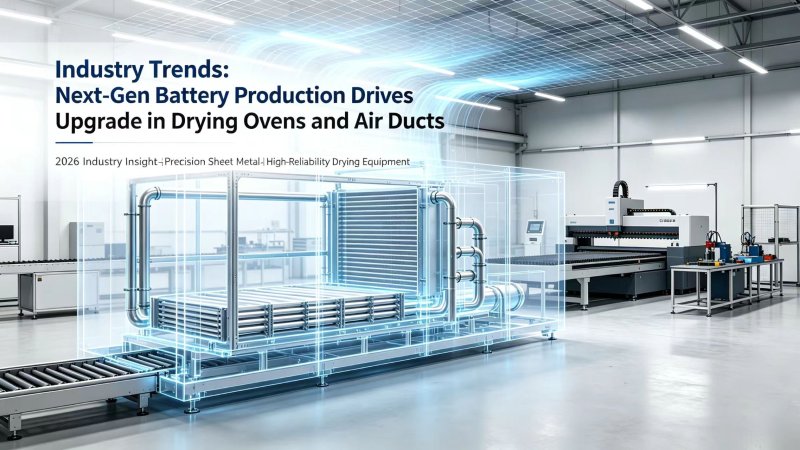
Industry Trends: Next-Gen Battery Production Drives Upgrade in Drying Ovens and Air Ducts
[September 2026] As energy leaders accelerate the adoption of high-energy-density and solid-state chemistries, battery manufacturing is shifting toward ultra-precision process engineering. In electrode coating and drying, advanced cell architectures place extreme demands on residual moisture control and thermal uniformity—forcing a comprehensive upgrade in industrial drying ovens and air duct structures.
Manufacturing Challenges: Micro-Airflow Uniformity & High-Seal Barriers
During high-speed electrode drying, subtle temperature variations or localized turbulence can trigger micro-cracking, foil warping, or active material delamination.
- Precision Airflow Systems: Industrial ovens require multi-zone thermal ramp control to synchronize bilateral electrode drying and solvent evaporation.
- Zero-Leakage Sealing: To prevent ambient humidity from penetrating the drying chamber, modern systems utilize inert gas purging. This requires high-integrity seam sealing across the oven chassis and places rigid demands on flexible square tube joints to withstand repeated thermal expansion.
Industry Insight
An industrial drying oven is both a thermodynamic unit and an ultimate test of precision sheet metal fabrication, heavy-duty welding, and anti-warpage design. Ensuring that large-scale air duct enclosures remain airtight and structurally sound through continuous high-temperature thermal cycles depends heavily on frame fabrication tolerances and compliant flexible joints.
As a long-standing partner in precision custom fabrication, we specialize in custom battery drying air ducts, high-seal square tube flexible connectors, and precision oven structural components. Utilizing strict welding standards and tight manufacturing tolerances, we deliver high-reliability hardware to global equipment integrators, empowering next-generation battery manufacturing worldwide.
Source Credit
This content is synthesized from global energy storage market briefings and cell fabrication technical updates (H2 2026) for industry knowledge sharing. All technical terminology belongs to its respective owners.