
[Tech Frontier] Dry Electrode Breakthrough: "Pre-lithiation" Tech Boosts EV Range by 20%
『 Global Intelligence Update 』
According to the latest industry reports in early 2026, Tesla has officially achieved scaled mass production of its "Full Dry Electrode" 4680 cells at Giga Texas and Berlin. As this technology becomes the new global standard, the performance bottleneck caused by thick electrodes has become the primary focus for R&D.
1. The Challenge: Initial Cycle Capacity Loss
- Context: The dry process allows for thicker electrodes to increase energy density but leads to significant irreversible lithium loss during the first cycle.
- The Problem: Thicker electrodes reduce initial coulombic efficiency, limiting the usable capacity and overall driving range.
2. The Solution: Dual-Function Lithium Metal Underlayer
A 2026 joint study by UNIST and Gachon University introduced a revolutionary "Lithium Metal Underlayer" to replace traditional adhesive primers:
- Dual-Purpose: It acts as a powerful conductive adhesive while serving as a lithium reservoir.
- Auto-Compensation: Lithium atoms migrate automatically to compensate for ions lost during the formation of the Solid-Electrolyte Interphase (SEI).
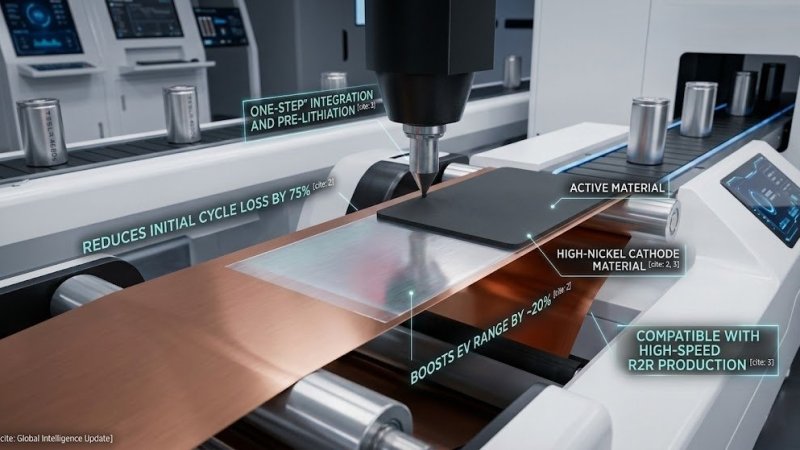
- Impact: Reduces initial capacity loss by 75%, translating to a ~20% increase in EV range.
3. Industrial Value: One-Step Roll-to-Roll Integration
- Process Efficiency: This "one-step" method unifies adhesion and pre-lithiation, fully compatible with existing High-Speed Roll-to-Roll (R2R) production.
- Compatibility: Highly effective for both NCM (High-Nickel) and LFP (Lithium Iron Phosphate) chemistries.
- Scalability: This breakthrough removes the "last mile" barrier for dry electrode adoption, paving the way for low-cost, high-energy-density EV batteries.